

Even in August, the inside of a campervan can stay cool
How to keep a campervan cool in an Aegean and Mediterranean summer: parking direction, shade, the awning, cross-ventilation, the roof fan and the electrical load of air conditioning. We've put what to do at which time of day into one chart.
Teknovan Editorial Team ·
The secret to keeping a campervan cool in an Aegean and Mediterranean summer is not letting the heat in. Park so the long side doesn't face the afternoon sun, block the sun outside before it reaches the windows and door, let the morning cool in and close up towards midday, and in the evening flush the whole van with cross-ventilation. Air conditioning works, but it depends on the campsite's hook-up and won't run for long on the battery. And most importantly: never leave a child or an animal in a parked vehicle in the heat, not even for a short time.
We covered general summer camping topics such as choosing a pitch, water, food and forest fires in our camping in the heat post. Here we focus on the campervan itself.
Parking direction and shade: get the first decision right
A campervan is a thin-walled box. Every surface the sun hits directly heats the inside, especially the windows and the door.
- Afternoon sun comes from the west and south-west. If possible, turn the campervan's long side with the big windows to face east or north. Have trees or other shade on the west-facing side.
- Cover the windscreen from outside. In a motorhome or camper van, the windscreen is the biggest way in for heat. An internal sunshade does something; an external reflective cover does much more, because the heat never reaches the glass.
- Put the awning out on the sunny side. The awning isn't just a sitting area; it also shades the campervan's side wall. Wind it in if the wind picks up.
- Choose between shade and the solar panel. In full shade a panel produces almost nothing. Think about your power needs in advance with our campervan power budget post.
That's why campsites in pine forests are valuable in summer. Ask for a shaded pitch when you book. On Teknokamp you can see the pitch's position on the campsite map and choose accordingly.
What to do at what time of day
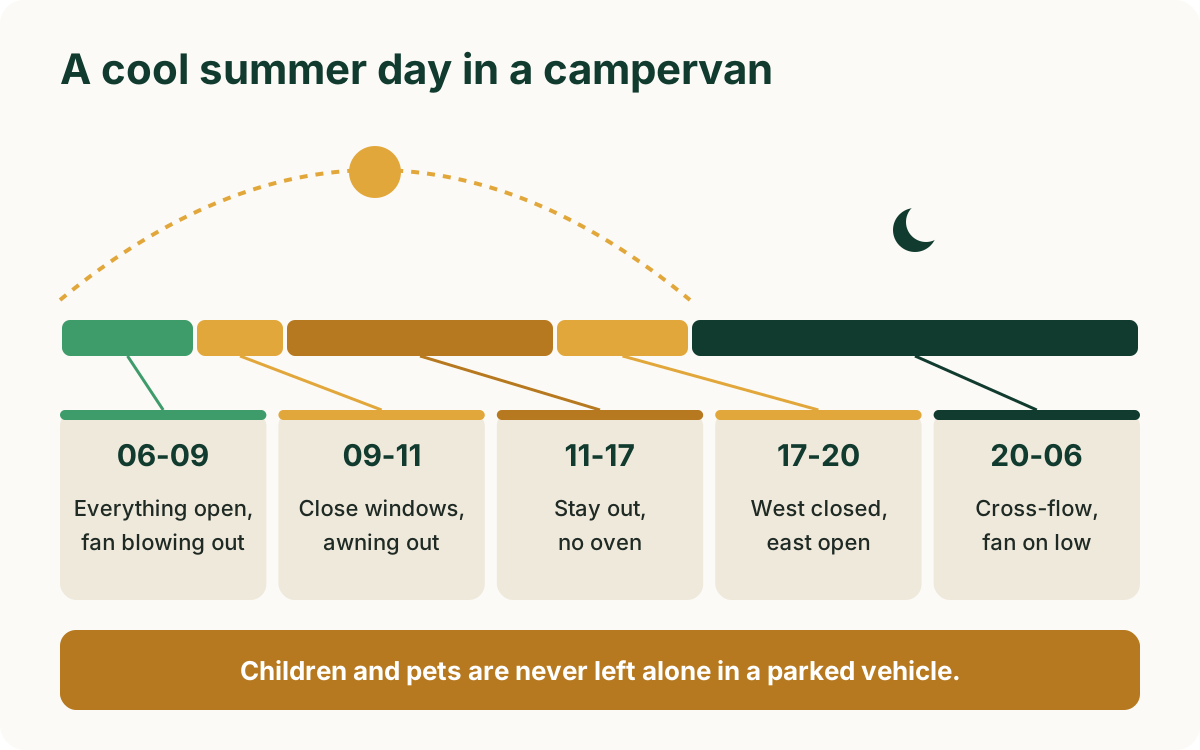
Keeping a campervan cool is a matter of timing. You open up while it's cooler outside than inside, and close up when the outside heats up.
| Time (approx.) | What to do |
|---|---|
| Early morning | Door, windows and roof vent open. Let the night cool in, run the fan blowing out. |
| Late morning | Close the windows that get sun, lower blinds and sunshades, put the awning out. |
| Midday and afternoon | Be in the shade or the sea, not inside the campervan. Don't use the oven or the hob. |
| Late afternoon | When the sun moves west, keep the west side closed and the east side open. |
| Evening and night | As it cools outside, open windows on opposite sides and use the roof fan to push hot air out. |
Cooking produces heat too. In summer, cook outside on a gas stove under the awning, or in the cool of the evening. You'll find the general rules on where the campsite allows it and provincial bans in our summer camping post.
Ventilation and the roof fan
Hot air rises. That's why the campervan's roof vent is the most valuable ventilation point.
- Set up a cross-flow. Open a low window on the shaded side and open the roof vent. Air comes in low and goes out high.
- Run the fan blowing out. Running the roof fan in extract mode pushes the warmed air out and draws cool air in through the window on the shaded side. In a closed campervan, blowing in just stirs the hot air around.
- Keep the fly screen closed. An open window at night means mosquitoes.
- If your fan has no rain sensor, decide whether to leave the roof vent ajar when you go out based on the forecast.
- Keep the fridge's rear ventilation grilles clear. The fridge struggles in the heat and uses more energy.
In campervans with gas appliances, the fixed ventilation vents are never blocked in any season. More on this in our campervan gas safety post.
Air conditioning and electrical load
Roof air conditioning is the quickest way to cool a campervan, but it's the heaviest electrical load.
- Run the air conditioning on mains hook-up. Running it from the battery through an inverter needs a large lithium battery and a powerful inverter, and drains the battery quickly.
- Ask the hook-up's amperage. A 6-amp hook-up gives about 1,380 W. If you also switch on a kettle or water heater while the air conditioning is running, the trip may go. Use high-power appliances one at a time.
- Turn the air conditioning on early and keep it on a low setting. Trying to cool a hot campervan at midday is much harder than keeping it cool from the morning.
- Door and windows closed, blinds down. While the air conditioning is on, windows in the sun are the biggest loss.
- If you'll run the air conditioning on a generator, ask the campsite's rules. Most don't allow generators during quiet hours. See our campsite quiet hours post for details.
Cool nights and sleep
On the Aegean coast, summer nights are often noticeably cooler than the day, but a closed campervan carries the heat it stored during the day into the night.
- In the late afternoon, open all windows and the door and flush the campervan for 20-30 minutes.
- Use a cotton sheet and a thin linen or cotton duvet cover instead of a bedspread.
- At night, leave one window and the roof vent open with fly screens. Run the fan on a low setting.
- Keep a water bottle beside you. You lose water at night in the heat too.
Never leave a child or pet in the vehicle
This is the most important rule in the post. The US National Highway Traffic Safety Administration (NHTSA) states that the inside of a parked vehicle can heat up by about 11 °C (20 °F) in 10 minutes, that leaving a window open a crack makes little difference, and that children's body temperature rises much faster than adults'. The Turkish Ministry of Health's heat warnings also say babies, children, people with disabilities and animals must never be left in a closed, parked vehicle.
A campervan may look like a house, but in the sun it's a closed vehicle. Even with the air conditioning on:
- If the power cuts out, the trip goes or the air conditioning fails, the inside heats up fast.
- If you'd leave your pet in the campervan while you go shopping or to the beach, don't do it in the hot hours. If you can't take it with you, change the plan.
- If you see signs of heatstroke (weakness, vomiting, confusion), move the person somewhere cool, wet their body and call 112.
Frequently asked questions
Can you get through summer in a campervan without air conditioning?
With a shaded pitch, a good roof fan, an external sunshade and the right timing, most days, yes. Plan to spend the afternoon in the shade or the sea, not inside the campervan.
Does campervan air conditioning run on the battery?
For a short time it may be possible with a large lithium battery and a powerful inverter, but it isn't practical. Run the air conditioning on the campsite hook-up.
Should the roof fan blow in or out?
During the day and in the evening, while it's hotter inside than out, run it blowing out. That pushes the hot air out and lets cool air in through the window on the shaded side.
Can I leave my dog in the campervan with the air conditioning on?
We don't recommend it. If the power cuts out or something fails, the inside heats up quickly. Keep your pet with you in the hot hours.
Sources
- NHTSA: Safety advisory, never leave children unattended in a vehicle
- Memurlar.net: Ministry of Health warning about the heat
- Turkish State Meteorological Service (MGM): İzmir official climate statistics
- Camping and Caravanning Club: Electricity for campers and caravanners
Image credits
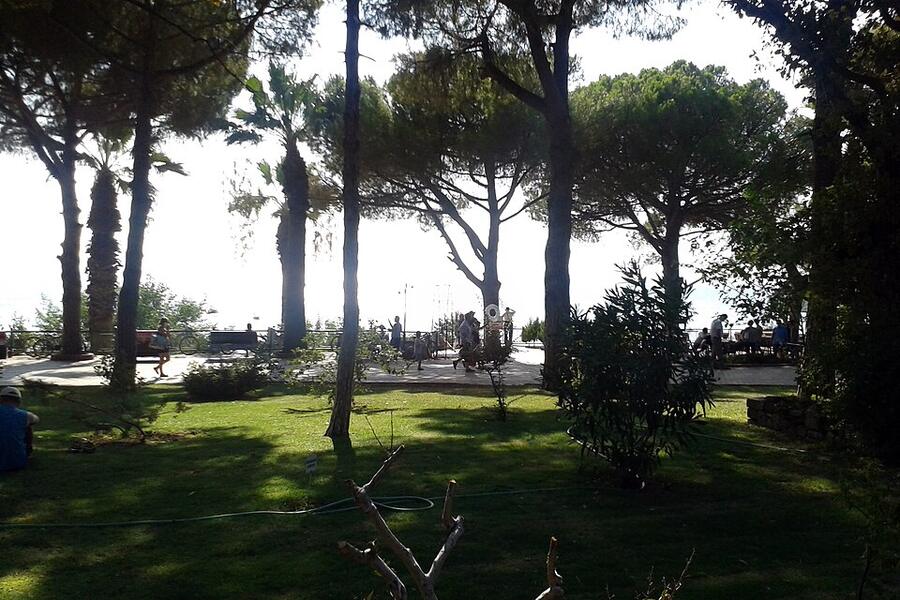
Photos illustrate the region; they are not photos of the campsites themselves.
- Ören, Burhaniye: Aziz Akbiyik, CC BY-SA 3.0, Wikimedia Commons