

How to work out a campervan power budget: battery, solar panel and hook-up
How much energy is in the battery, how much do the fridge, lights, phones and laptop use in a day, and how do solar panels and inverters fit into the sums? An itemised daily example and what to watch for when plugging into the campsite hook-up.
Teknovan Editorial Team ·

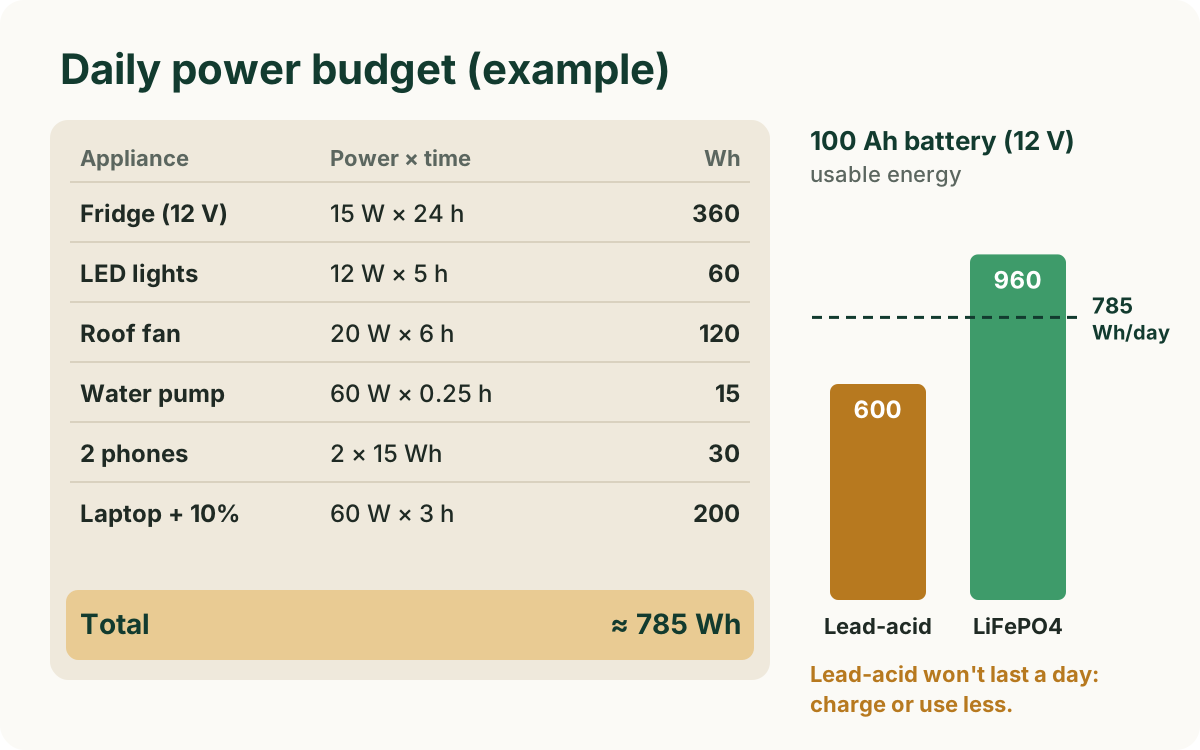
Three numbers are enough to find out how many days your campervan's electricity will last: the energy in the battery you can actually use (Wh), your appliances' daily consumption (Wh) and the daily charge from sources such as solar panels or hook-up (Wh). Divide the usable energy by consumption minus charge. In the example below you'll see that a campervan for two uses about 800 Wh a day, and that a 100 Ah lead-acid battery can't cover even one day of that without charging.
We covered the water tank, grey water and gas in our post on water, electricity and waste in a campervan. Here we only do the electricity sums.
Ah, Wh, and the difference between 12 V and 230 V
The battery label usually shows amp hours (Ah). For the sums, convert this to watt hours (Wh), because appliance labels show watts (W):
Wh = Ah × V. A 12 V 100 Ah battery holds 1,200 Wh of energy on paper.
But you can't use all of it:
- For lead-acid, AGM and gel batteries, a common rule is not to use more than half the capacity. Discharging deeper shortens battery life. The usable share of 100 Ah is about 600 Wh.
- Lithium iron phosphate (LiFePO4) batteries can be discharged much more deeply. Go by the limit the manufacturer gives. In our example we took 80%: about 960 Wh.
A campervan has two separate circuits. The 12 V circuit powers lights, the water pump, the fan, most fridges and the USB sockets, running directly from the battery. The 230 V circuit is the same as the sockets at home. It comes either from the campsite hook-up or from the battery through an inverter. When an inverter converts 12 V to 230 V, some energy is lost as heat. Efficiency varies by model, so use the figure in the manual. We added 10% to the sums.
Work out daily consumption item by item
For each appliance, multiply power (W) × daily running time (hours), then add them up. Take the values from your own appliances' labels. The figures below are example assumptions for a summer day for two people.
| Appliance | Sum (example) | Daily |
|---|---|---|
| 12 V compressor fridge | average 15 W × 24 hours | 360 Wh |
| LED lights | 4 × 3 W × 5 hours | 60 Wh |
| Roof fan | 20 W × 6 hours | 120 Wh |
| Water pump | 60 W × 15 minutes | 15 Wh |
| Two phones (USB) | 2 × 15 Wh | 30 Wh |
| Laptop (via inverter) | 60 W × 3 hours + 10% loss | 200 Wh |
| Total | about 785 Wh |
Watch the fridge line. A compressor fridge doesn't run constantly; it switches on and off as the thermostat kicks in. Its average power depends on the outside temperature, how often you open the door and how well the fridge is ventilated. In August this line can double. If you have a gas (absorption) fridge running on gas, this line drops to almost zero, but on 12 V it draws much more. Check the manual.
Result: 785 Wh exceeds the 600 Wh usable from a 100 Ah lead-acid battery. A LiFePO4 battery of the same capacity just about gets through one day. If you want to go two days without charging, you need to either cut consumption or increase capacity.
The quickest ways to cut consumption:
- Charge phones and laptops from USB or 12 V sockets rather than through the inverter.
- Keep the fridge on the shady side with its ventilation grille clear, and don't put hot food in before it cools.
- Use heat-producing appliances such as kettles, hair dryers and electric heaters only on mains hook-up.
- Run the fan on a low setting at night.
How solar panels fit into the sums
The wattage on a panel's label is its peak power under laboratory conditions. Because the angle of the sun changes through the day, panels lose efficiency in the heat and there's shade at times, real daily output is much lower.
The easiest way to get a realistic figure for your location is the European Commission's free PVGIS tool. Choose your campsite on the map, enter the panel's power and angle, and you'll see the average daily output for each month in Wh. Subtract that from the total above.
In practice, remember three things:
- Shade is a panel's enemy. A shady pitch in a pine forest keeps you cool but almost stops the panel. In summer you may have to choose between cool and charge. A portable panel can sit in the sun while the campervan stays in the shade.
- A charge controller (MPPT or PWM) between panel and battery is essential. If you use a lithium battery, choose the controller's lithium profile.
- In autumn and winter the days are short and output drops to a fraction of summer's. In these months, sites with hook-up make life easier.
Plugging into the campsite hook-up (CEE)
On most European campervans, the external connection is a blue three-pin CEE (IEC 60309) plug. At campsites in Türkiye you may find either CEE or ordinary household sockets. Ask the socket type before you go and bring a suitable adapter if needed.
The real question when you plug in is how many amps the hook-up provides. On a mains supply of about 230 V:
| Fuse | Maximum at once |
|---|---|
| 6 A | about 1,380 W |
| 10 A | about 2,300 W |
| 16 A | about 3,680 W |
On a 6-amp hook-up, the trip may go if a kettle, a charger and the fridge run at the same time. The campervan's own internal fuse may also be lower than the hook-up. Run high-power appliances one at a time. If you'll use air conditioning, ask about the amperage when you book.
For safety:
- Fully unwind the cable from the reel. A coiled cable heats up under load.
- If the cable crosses a track or footpath, lay it so vehicles won't drive over it.
- Plug into the campervan first, then the campsite socket. Do the reverse when disconnecting.
- Don't plug in or unplug with wet hands or in the rain.
If you're looking for a shady pitch with electric hook-up, you can check campsite details in the campsite list. At campervan parks such as İzmir Ayaz Karavan Park, you can choose your pitch on Teknokamp's map and complete the booking.
Frequently asked questions
How many days does a 100 Ah battery last in a campervan?
It depends on your consumption. The usable share of a 100 Ah lead-acid battery is about 600 Wh. At 300 Wh a day it lasts two days; at 800 Wh a day, less than one.
Can a campervan battery run the air conditioning?
For a short time it may be possible with a large lithium battery and a powerful inverter, but it drains the battery very quickly. Leave the air conditioning to mains hook-up. Details in our keeping a campervan cool post.
Is a solar panel enough on its own?
In summer on an open pitch, if you keep consumption low, it can be enough on most days. In a shady spot and on short days it isn't. Use PVGIS to work it out for your location.
Does the battery charge while the engine is running?
In most campervans the vehicle's alternator also charges the leisure battery, but how fast depends on the installation. If you're hiring, ask at handover.
Sources
- European Commission JRC: PVGIS solar energy calculation tool
- Camping and Caravanning Club: Electricity for campers and caravanners
- Eurocampings: Electricity at the campsite
Image credits
Photos illustrate the region; they are not photos of the campsites themselves.
- Gümüldür: BIG-K006, CC BY 4.0, Wikimedia Commons