

10 checks for gas bottle safety in a campervan
How to check the bottle, regulator and hose, how to look for leaks with soapy water, where to fit a gas alarm and why the bottle stays off while driving. A short, practical checklist for LPG in a campervan.
Teknovan Editorial Team ·

Using gas bottles safely in a campervan comes down to four habits: checking the connections with soapy water every time you change a bottle, judging the hose and regulator by their age and appearance, never blocking the ventilation vents and keeping the bottle valve closed while driving. Add a gas alarm and a carbon monoxide detector, and you've largely managed the most serious risk in a campervan.
We cover carbon monoxide and heating in enclosed spaces separately in our post on water, electricity and waste in a campervan. This post is about the bottle, regulator, hose and leaks.
Know the system: bottle, regulator, hose, valves
A campervan's gas system usually consists of these parts:
- Bottle: Filled with LPG (butane and propane). It stands upright and secured in the campervan's gas locker.
- Regulator: Reduces the high pressure in the bottle to the low pressure the appliances use. In some campervans it sits on top of the bottle; in others it's fixed to the locker wall.
- Hose: The flexible part between the bottle and regulator, or between the regulator and the fixed pipe. It's the part of the system that ages fastest.
- Appliance valves: Separate shut-off valves for the hob, heater, fridge and water heater, usually lined up inside a kitchen cupboard.
The connections on campervans coming from Europe may not fit Turkish bottles. In that case buy the right regulator or adapter from an authorised dealer; don't improvise a connection. We cover the road side of this in our post on campervanning on Turkish roads.
A 10-point safety check
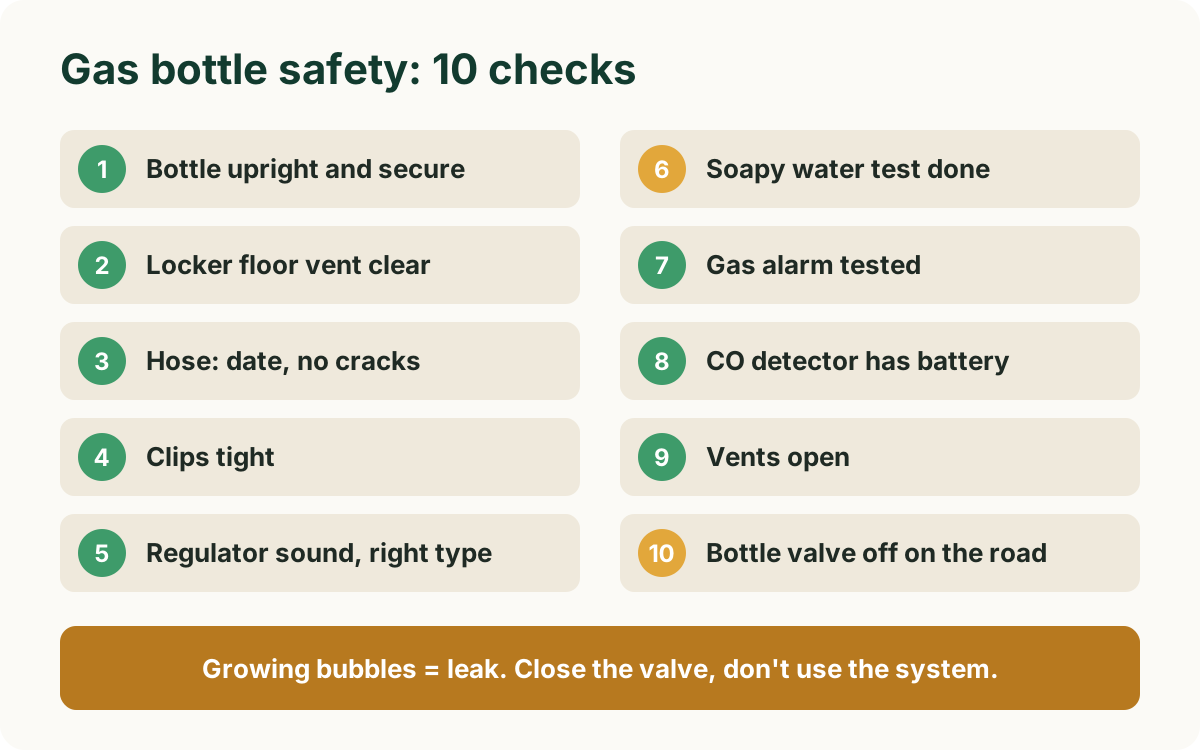
- Is the bottle upright and secure? The strap or clamp should be sound. From a bottle lying on its side, liquid gas can reach the regulator.
- Is the low vent in the gas locker clear? LPG is heavier than air, so leaking gas collects low down. The vent in the locker floor is there to let it out. Don't put things in front of it.
- The date and condition of the hose. If there are cracks, hardening, kinks or swelling, replace it. Bend the hose gently; if fine cracks appear on the surface, it has aged. For replacement intervals, follow the marking on the hose and the vehicle's handbook.
- Are the clips tight? The clips at the ends of the hose shouldn't be loose. The hose shouldn't touch a heat source, a sharp edge or moving parts.
- Is the regulator sound and the right type? There should be no cracks, rust or signs of forcing on the body. Don't force a regulator that doesn't fit the bottle.
- Has the soapy water test been done? We explain it step by step below. It's essential after every bottle change.
- Does the gas alarm work? Press the test button. Because LPG is heavy, an LPG alarm is fitted close to the floor.
- Is the carbon monoxide detector in place? It doesn't replace a gas alarm; it's a separate device. Check its battery.
- Are the fixed vents open? Roof and floor vents aren't closed even in the cold. Burning needs air.
- Is the bottle off while driving? Unless your vehicle's handbook describes a system designed for use on the road (such as a regulator with a crash sensor), close the bottle valve. Turn off all flame appliances when entering a petrol station too.
How to do a soapy water leak test
Never use a lighter or matches to look for a leak. Soapy water is enough and it's safe.
- In a container, mix water with a little liquid soap or washing-up liquid. Don't whip it into foam; it should be runny. You can also use a ready-made leak detection spray.
- With the valves of the hob and all appliances closed, open the bottle valve. That puts the system under pressure.
- With a brush or spray bottle, apply the mixture to the connection between the bottle valve and regulator, to both ends of the hose and along the hose.
- Watch for a few seconds. Growing bubbles mean a leak.
- If there's a leak, close the bottle valve, take the connection apart, check the washer, reconnect it and test again. If it persists, don't use the system; have an authorised service centre look at it.
- When the test is done, wipe the soap off the connections. Detergent residue can corrode metal parts over time.
This test only checks the connections you can reach. Have the fixed pipes under cupboards and the floor checked by an authorised service centre at regular intervals.
If you smell gas
An odorant is added to LPG so leaks can be noticed. If you smell gas in the campervan:
- Close the bottle valve.
- Open the door and windows.
- Don't touch electrical switches, don't turn lights on or off, don't pull plugs, and don't use your phone or a lighter. Reduce the risk of a spark to zero.
- Leave the campervan and make sure nobody smokes nearby.
- If the smell doesn't go away or you can't find the source, call 112 and tell the campsite staff.
If headache, dizziness and nausea come together, it could be carbon monoxide. Likewise, get outside and call 112.
Ferry, tunnel and travel rules
When boarding a ferry or entering a tunnel or bridge with a campervan carrying gas, the rules vary by operator. As of the time of writing (November 2026), the general picture is:
- Ferries: Most operators require the bottle valve to be closed and gas appliances not to be used on board. When you buy your ticket, say your vehicle is a campervan carrying gas bottles and ask the operator's current rules.
- Eurasia Tunnel (Istanbul): Open only to light vehicles of certain classes, with a height limit. Vehicles with trailers and tall motorhomes generally can't use it for that reason. Check the current rules on the tunnel's official website.
- Channel Tunnel (LeShuttle): According to its published rules, it doesn't carry LPG-powered vehicles or fixed LPG tanks in campervans. Portable bottles are accepted within certain weight limits and provided the gas is turned off. If you're travelling abroad, check the operator's own page.
The same rule applies in every case: on the road, on board and in tunnels the bottle is off, and the fridge is on 12 V or off.
Frequently asked questions
How often should a campervan gas hose be replaced?
There's no single interval. Follow the date marking on the hose and the vehicle's handbook. If you see cracks, hardening or swelling, replace it without waiting for the date.
Is a gas alarm the same as a carbon monoxide detector?
No. A gas alarm detects LPG leaks; a carbon monoxide detector detects the toxic gas produced by combustion. A campervan should have both.
Can the fridge run on gas while driving?
Not unless your vehicle's handbook explicitly describes a system that allows it. On the road, run the fridge on 12 V and turn the gas off.
Can I keep a spare bottle in the gas locker?
Yes, if the locker is designed for two bottles, with both secured and upright. Don't carry a spare bottle inside the campervan, under the bed or next to the cab.
If you're connecting a bottle for the first time, also see the handover steps in our first campervan trip checklist. Other checks for the start of the season are in our campervan maintenance post.
Sources
- Ministry of Labour and Social Security: safe use of pressurised gas cylinders (PDF)
- Aygaz: Bottled gas frequently asked questions
- Caravan and Motorhome Club: How to stay gas-safe when touring
- Camping and Caravanning Club: Expert guide to gas for caravans and motorhomes
- LeShuttle: Carriage of dangerous and hazardous goods
- Eurasia Tunnel official website
Image credits
Photos illustrate the region; they are not photos of the campsites themselves.
- Erdek: Kızıldeniz, CC BY-SA 4.0, Wikimedia Commons