

Your dog and cat can come on the campervan trip too
Travelling by campervan with a pet: safe transport in the vehicle, heat and hot tarmac, campsite rules, leads, ticks and fleas, vaccination records and microchips. A preparation checklist before you set off.
Teknovan Editorial Team ·

A campervan holiday with a pet is much easier than a hotel. Your animal sleeps with its own blanket and water bowl, in the same place as you. The hard part comes down to three things: safe transport on the road, heat, and the campsite's rules. In short: secure your pet while driving, never leave it alone in the vehicle in the heat, ask the campsite in advance and mention it in your booking, and keep vaccinations and tick protection up to date. This post goes through each in detail.
On the road: a loose animal is a risk
An animal roaming freely inside a moving campervan is dangerous for both of you. It can be thrown forward when you brake hard or get under the driver's feet. The American Veterinary Medical Association (AVMA) warns that unrestrained animals can be thrown around inside the vehicle or out through a window in a crash.
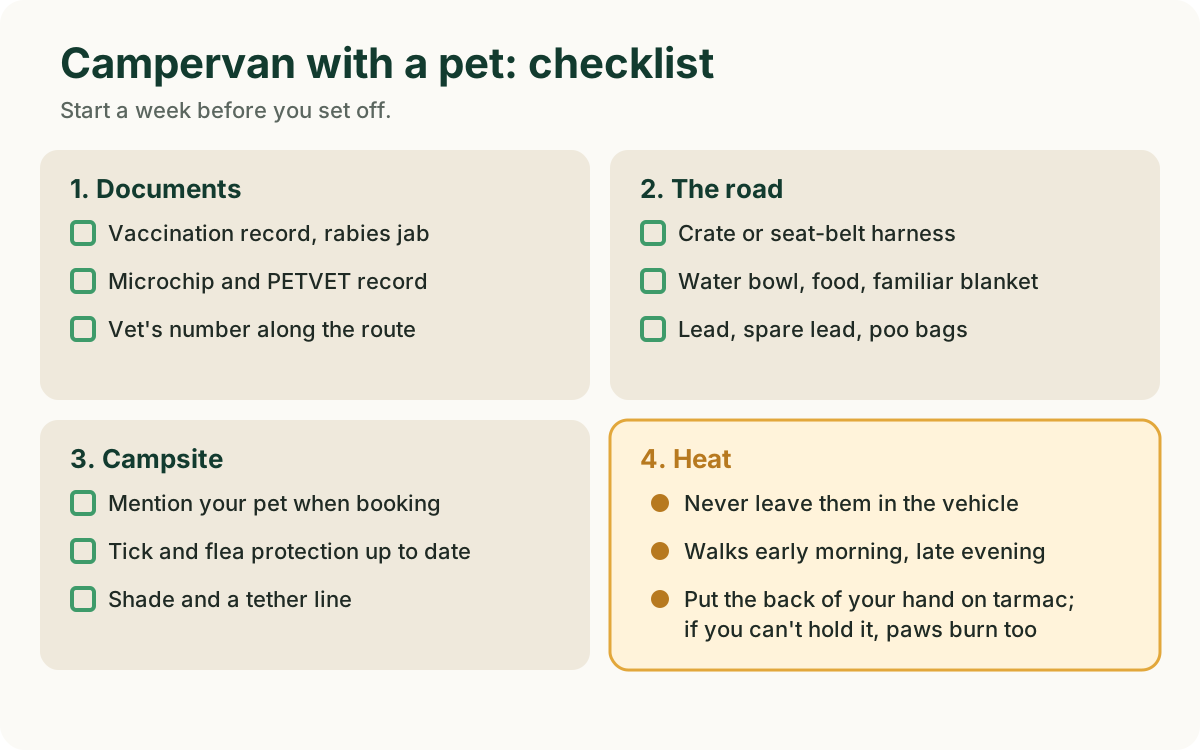
- For dogs, the two most common options are a secured travel crate or a harness attached to a seat belt. Don't attach the seat belt to a neck collar; in a hard stop it puts strain on the neck.
- For cats, a closed, secured carrier. Cats tend to bolt in a new environment, so know where the cat is when you open the campervan door.
- Take breaks. Toilet and water breaks for dogs can be planned together with your own. At the stop, put the lead on before getting out, then open the door.
- Do a practice run. Before the long trip, go for a few short drives. Your pet gets used to the sound and movement of the campervan.
Keeping the first day's drive short makes things easier for both of you. For more on driving a campervan, see our campervan driving techniques post.
Heat: never leave them alone in the vehicle
This is the most important sentence in the post. According to the AVMA, the inside of a parked vehicle can heat up by about 11°C (20°F) in 10 minutes and by more than 22°C (40°F) within an hour, even when it's only mild outside. Leaving a window open a crack doesn't significantly reduce this. A campervan is a vehicle too. A campervan in the sun heats up quickly if the air conditioning fails or the power cuts out, even if it was running.
On the Mediterranean and Aegean in summer, there are two more risks:
- Hot tarmac and concrete. Tarmac in the sun can be much hotter than the air and can burn paws. A practical test: put the back of your hand on the ground. If you can't comfortably hold it there, your pet can't walk on it.
- Walks in the midday heat. Move walks to early morning and late evening. Short-nosed breeds and old or overweight animals are more sensitive to heat.
Rapid panting, excessive drooling, lethargy and staggering can be signs of heatstroke. Move the animal into the shade immediately, wet it with cool (not ice-cold) water and contact a vet. We've gathered other summer camping precautions in our camping in the heat post.
At the campsite: ask first, then come
Not every campsite accepts pets. Those that do have their own rules: leads required, no entry to certain areas, limits on number or size, an extra fee. Find these out before you book, not when you arrive.
- Mention it in your booking. On Teknokamp, when you choose your pitch on the campsite map and book, you can tick the "I'm bringing my pet" option to let the owner know in advance.
- Lead. Keep your pet on a lead at the campsite. Not everyone likes dogs, some children are afraid, and there may be another dog on another pitch.
- Tethering. If you're tying your pet up on the pitch, set the length of the line so it can't reach the track or the next pitch. Provide shade and keep the water bowl full at all times.
- Poo. Pick it up with a bag and put it in the campsite bin.
- Noise. A dog that barks constantly disturbs neighbours during quiet hours. Don't leave your pet alone on the pitch.
- Beach. Pet rules on beaches vary by municipality and beach. Ask before you go.
We explain what you'll be asked on arrival and the check-in steps in our arriving at the campsite post.
Ticks, fleas and the vet
Ticks and fleas are common in the scrub and grassland of the Aegean and Mediterranean. Before setting off, make sure your pet's external parasite protection is up to date. Let your vet decide which product to use and how often. After every walk, check behind your pet's ears, under the armpits, between the toes and around the belly.
Ticks can be a risk for people too. The Turkish Ministry of Health advises not to touch a tick attached to a person with bare hands and not to crush it, and to go to the nearest health facility if you can't remove it properly. Don't forget to check yourself.
Before you set off, note the vet clinics along your route and the nearest out-of-hours vet. Campsites can usually recommend a vet nearby.
Documents: vaccination record and microchip
As of the time of writing (November 2026), in Türkiye owned cats, dogs and ferrets must be identified with a microchip and registered in the PETVET system of the Ministry of Agriculture and Forestry. Vaccinations, including rabies, are also kept in this record. For current rules, check the announcements of the ministry's provincial directorates and ask your vet.
Keep with you:
- Vaccination record or pet passport
- Microchip number (with a photo of it on your phone)
- Medicines your pet takes and their doses
- A recent photo (for a notice if it gets lost)
- Your own vet's phone number
If you're travelling abroad or coming from abroad, there are separate entry and exit rules for animals. Check them in an official source weeks before you travel.
Frequently asked questions
Can I leave my dog in the campervan at the campsite and go to the beach?
Not in the hot season. Even in the shade with the air conditioning on, the inside of the campervan can heat up quickly. A dog left alone may also bark and disturb the neighbours. Make a plan that lets you take your pet with you.
Can I go on a campervan holiday with my cat?
Yes, but cats are more sensitive to a change of surroundings than dogs. Put the litter tray in a fixed place, make sure the cat is shut inside when you open the door, and don't let it out for the first few days.
Which campsites accept pets?
It varies from site to site. You can check campsite details in the Teknovan campsite list and, to be sure, ask the owner before booking.
What should I do if a tick attaches to my pet?
Remove the tick with a suitable tick tool without crushing it, or go to your vet. If you notice lethargy, loss of appetite or fever in the following days, see a vet.
Sources
- AVMA: Safe non-commercial transport of pets in motor vehicles
- AVMA: Pets in vehicles
- Ministry of Agriculture and Forestry, Eskişehir Provincial Directorate: digital identification of owned animals
- Ministry of Agriculture and Forestry of Türkiye
- Ministry of Health of Türkiye, General Directorate of Public Health
- TRT Haber: warning not to touch a tick attached to the body with bare hands
- Teknovan: Campsites
Image credits
Photos illustrate the region; they are not photos of the campsites themselves.
- Karagöl, Yamanlar: Enverkaranfil, CC BY-SA 4.0, Wikimedia Commons