
How to handle wind, hills and reversing when driving a campervan
Swaying in crosswinds, brakes overheating on long descents, the rear overhang swinging out on bends, and a spotter for reversing. Practical techniques for driving a campervan safely.
Teknovan Editorial Team ·
Driving a campervan isn't harder than driving a car, but it is different. The vehicle is taller, longer and heavier. These three differences ask you to change five habits: slow down in wind, brake with the gears on descents, take bends wide, get someone to help you reverse, and leave more space to the vehicle in front. This post goes through those five habits one by one. For rules such as licence categories, HGS tolls and speed limits, see our post on campervanning on Turkish roads. Here the topic is what you do behind the wheel.
Crosswinds: a campervan is a sail
A campervan's side is two or three times the area of a car's. When the wind hits it, it pushes the vehicle within the lane. You feel it most on bridges, at valley mouths, on exposed coast roads and when lorries pass. On the Aegean coast the wind can pick up on summer afternoons, more noticeably on peninsula roads.
- Reduce speed. The effect of wind increases with speed. When you see a wind warning sign or feel the steering start to pull, the first thing to do is ease off the accelerator.
- Hold with both hands and make small corrections. A sudden, big steering movement is more dangerous than the wind.
- Be ready when passing a lorry. A large vehicle passing from in front or alongside first pushes you, then pulls you. Move slightly towards the right of your lane and hold the wheel steady.
- If a towed caravan starts to snake: ease your foot off the accelerator slowly, don't brake suddenly, and don't try to "catch" the caravan with the steering. As the vehicle slows, the caravan settles. The most common cause of snaking is poor load distribution: put heavy items low and close to the caravan's axle, and keep the nose weight on the towbar within the range in your vehicle's handbook.
Long descents: gears, not brakes
If you keep your foot on the brake on a long descent, the brake pads heat up and braking power drops. This happens sooner the heavier the vehicle. The solution is engine braking.
- Slow down on the flat before the descent begins.
- Change down one or two gears. An old rule of thumb: "Go down a hill in the gear you'd use to climb it."
- In an automatic, use manual or "L" mode. Some motorhomes also have a dedicated descent mode; check the handbook.
- Use the brakes in short, firm presses rather than continuously. Press when your speed rises, release when it drops.
- If you smell burning brake pads, stop somewhere safe and wait for the brakes to cool.
Many roads from the mountains down to the sea on the Aegean and Mediterranean are like this. On narrow, winding roads such as Mount Yamanlar, this technique matters even more.
Bends and turning circle: don't forget the rear overhang
Two things happen when a campervan turns. First, the rear wheels track inside the front wheels. So when turning at a junction or in a village square, a rear wheel can catch a kerb, a post or a parked car. With a towed caravan the difference is even bigger. Second, the overhang between the rear axle and the back of the campervan swings out in the opposite direction to the turn. When pulling out of a tight spot, that overhang hits the wall or car behind.
In practice, these help:
- Go a little further into the turn and turn the wheel later.
- While turning, look in both mirrors, not just ahead.
- Before entering a petrol station or supermarket car park, see the way out.
- When pulling out of a tight spot, think about where the rear overhang will go before turning the wheel to full lock.
Dimensions: on paper, not in your head
Measure the campervan's height including the air conditioning unit, aerial and solar panels on the roof. Know its width including mirrors. Write these two numbers on a small label and stick it on the dashboard. Low bridges, tunnels, car park barriers, petrol station canopies and balconies in villages are the things most often hit. When you see maximum height and width signs by the road, look at your label instead of working it out in your head.
Branches are another matter. On roads to forest campsites, low branches can damage the roof vent and the awning. If in doubt, stop, get out and look.
Following distance and load: heavy vehicles stop late
The heavier the vehicle, the longer the stopping distance. A campervan with a full water tank, full cupboards and two bikes on the back stops later than when it's empty. Don't exceed the maximum laden weight in the registration document. If you're not sure, weigh the vehicle at a weighbridge before setting off.
The rule of thumb taught at Turkish driving schools is that your following distance in metres should be at least half your speed. The UK's Highway Code recommends leaving at least a two-second gap on fast roads and at least doubling it on wet roads. In a campervan we suggest going further still and leaving at least four seconds to the vehicle in front even on a dry road. To count, pick a post the vehicle in front passes and count "one thousand and one, one thousand and two...".
| Situation | What to do |
|---|---|
| Windy bridge or exposed coast road | Reduce speed, hold with both hands, make small corrections |
| Long, steep descent | Change down, use the brakes in short presses |
| Tight junction or village square | Turn wide, look in both mirrors |
| Low underpass or barrier | Check the height on your label; if unsure, stop |
| Rain, night, tiredness | Increase following distance, take a break |
Narrow village roads and reversing
Some campsites are reached through a village or along a forest road. The shortest route your navigation shows isn't always the right one for a campervan. Before setting off, look at the last few kilometres on satellite view and note places where you could turn round. When a vehicle comes the other way, look ahead for the nearest passing place rather than reversing. Don't put a wheel onto soft ground or into a ditch at the roadside; the verge can collapse under the campervan's weight.
The most important rule for reversing is simple: if you can't see, stop. There's an English acronym for it, GOAL: "Get out and look". Even with mirrors and a camera, you can't fully see behind a campervan.
If someone is with you, make them your spotter. The spotter stands not directly behind the vehicle but at the rear corner on the driver's side, where you can see them in the mirror. Shouting doesn't work; engine noise and wind swallow the words. Agree on hand signals together before setting off, and practise once in an empty car park before you reach the campsite.
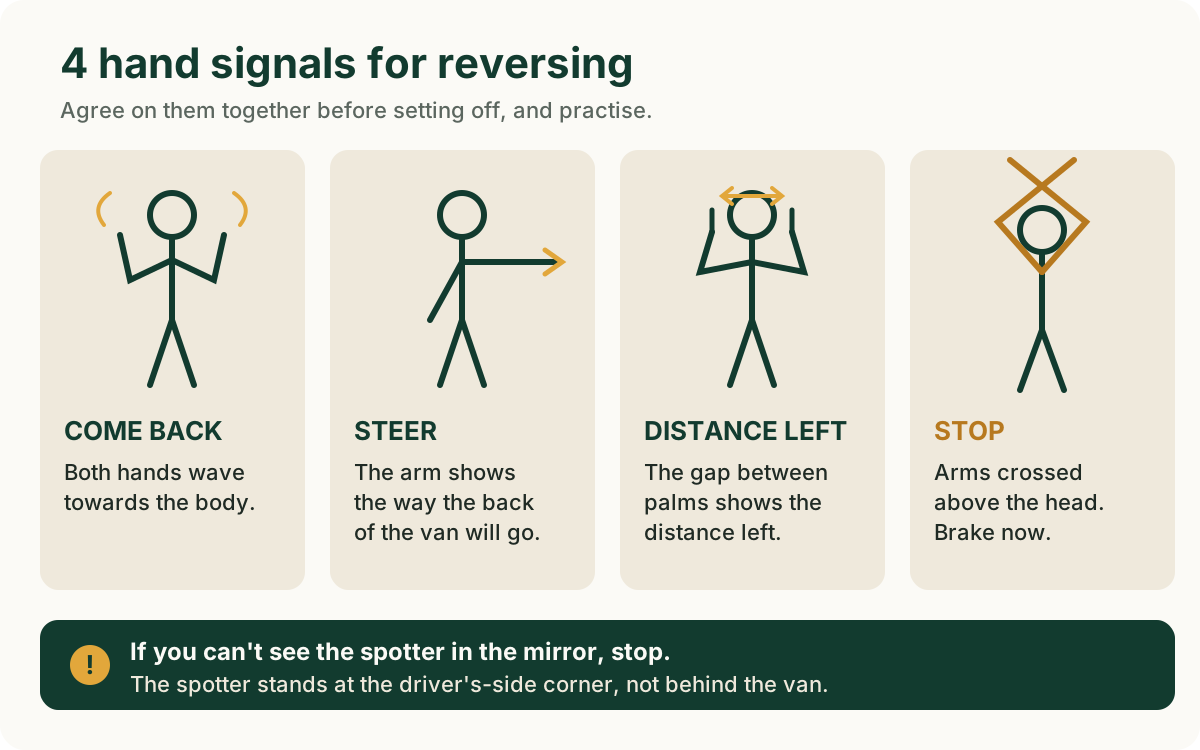
There's one more trick for reversing with a towed caravan: put your hand at the bottom of the steering wheel. If you move your hand to the left, the back of the caravan goes left too. This makes it easier to use steering that works the opposite way without thinking. Make small, slow movements; if the caravan starts to jackknife, stop, pull forward a little and straighten up.
The same calm applies when you arrive at the campsite. When choosing a pitch on the campsite map on Teknokamp, picking one near the entrance with plenty of room to manoeuvre shortens the first night's parking. We cover other preparations for your first trip in our first campervan trip checklist.
Frequently asked questions
How fast should I drive a campervan on the motorway?
Legal limits vary by vehicle type and road and, as of the time of writing (November 2026), can be checked on the pages of the Traffic Department of the General Directorate of Security. Drive below the legal limit, at a speed you feel comfortable with given the wind and load. In a campervan, fuel consumption also rises noticeably with speed.
Should I brake if the caravan starts to snake?
Don't brake suddenly. Ease your foot off the accelerator slowly and hold the wheel steady. As the vehicle slows, the caravan usually settles. Then stop and check the load distribution.
Is a reversing camera enough?
A camera helps but isn't enough. It shows a narrow area and may not show low branches or posts to the side. A spotter or the "get out and look" rule still applies.
Is driving a campervan at night a problem?
It isn't forbidden, but it makes things harder on narrow roads and when entering a campsite you don't know. If possible, plan to arrive at the campsite in daylight.
Sources
- General Directorate of Security, Traffic Department
- General Directorate of Highways (KGM)
- Highway Traffic Law No. 2918 (mevzuat.gov.tr)
- GOV.UK: The Highway Code, rule 126 and stopping distances
- Caravan and Motorhome Club: Advice and training
- Teknovan: Campsites
Image credits
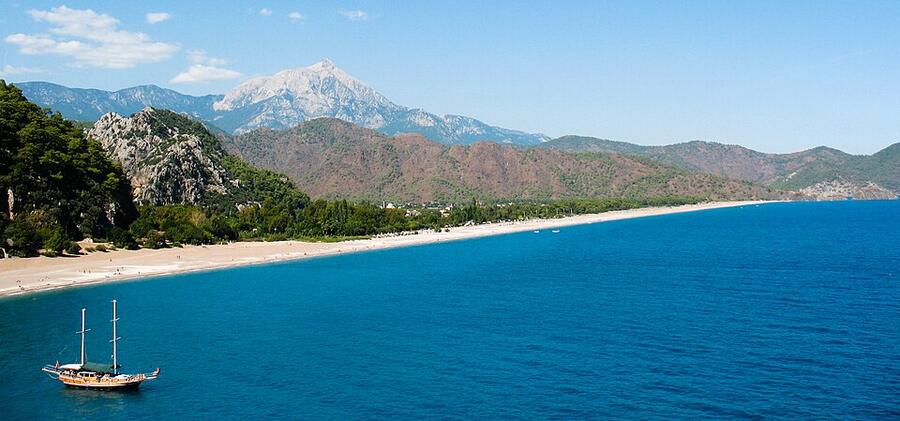
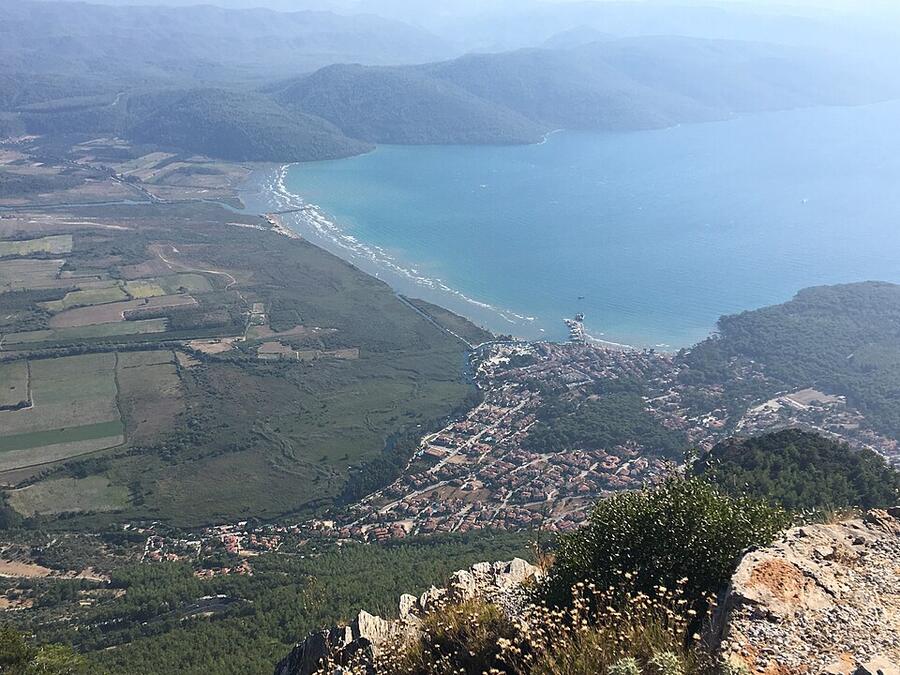
Photos illustrate the region; they are not photos of the campsites themselves.
- Gökova Körfezi: Iemizrak, CC BY-SA 4.0, Wikimedia Commons