

Campervan maintenance when the season opens and closes
Checks to do at the start and end of the season for tyres, brakes, the water system, seals and the battery. Why winterising is needed even in the mild Aegean winter, what you can do yourself and what to leave to a garage.
Teknovan Editorial Team ·
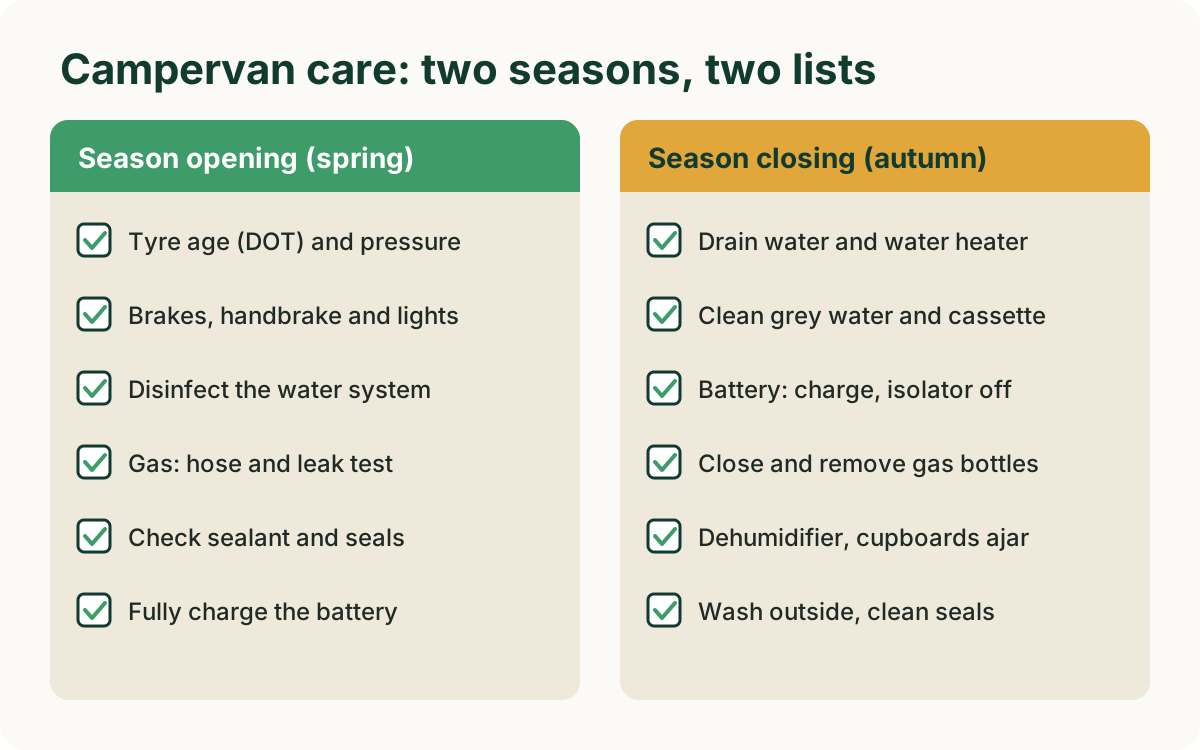
There are two big moments in campervan maintenance. When the season closes, the aim is to get the vehicle through winter undamaged: drain the water, protect the battery, prevent damp and leaks. When the season opens, the aim is to set off safely: confirm that tyres, brakes, lights, gas and the water system all work. You can do most checks yourself in an afternoon. Jobs such as brakes, the fixed gas installation and the chassis are best left to an authorised garage once a year.
This list is written for people who own their campervan. In a hired campervan these jobs are the company's responsibility, but checking the same points at handover saves you time.
What you do yourself, what's left to the garage
| Job | Yourself | Authorised garage |
|---|---|---|
| Tyre pressure, tread depth, manufacture date | Yes | Replacement and balancing |
| Brakes | Visual check, handbrake | Pads, adjustment, overrun brake mechanism |
| Water system | Draining, disinfection, filter | Pump and water heater faults |
| Gas | Hose, soapy water test | Fixed installation check |
| Seals | Visual check, moisture meter | Damp test and repair |
| Battery | Charging, cleaning terminals | Capacity test |
When the season closes: getting ready for winter
Winters on the Aegean and Mediterranean coast are mild, but inland and at altitude there's frost at night. If you're keeping the campervan away from the coast, in the garden of a village house or up in the hills, the risk is real. And often the real enemy over winter isn't frost but damp.
- Drain the water system completely. Switch off the water pump, open all taps and the shower, and open the drain valves on the fresh water tank and the water heater. Water left in the heater does the most expensive damage if it freezes. Leaving the drain valves open all winter is the recommended method. Follow the order in your vehicle's handbook.
- Empty and clean the grey water tank and the toilet cassette. Store the cassette with the lid open so it dries.
- Protect the battery. A battery left connected for a long time discharges by itself, and deep discharge shortens its life. Either fully charge the battery, switch off the main isolator and check it once a month, or keep it on a smart charger suitable for campervans.
- Turn off and remove the gas bottles. Store them upright somewhere airy and out of the sun.
- Empty the fridge and leave the door ajar. A fridge left closed smells of mould.
- Manage damp. Lift mattresses and cushions and stand them on edge, leave cupboard doors ajar and put out moisture absorbers. Air the van once a month if you can.
- Wash the outside and check the seals. Bird droppings, resin and salty air damage paint and seals over winter. Clean the seals on windows, the roof vent and doors.
- Protect the tyres. If the vehicle will stand for a long time, keep the sun off the tyres and keep the pressure at the handbook value. Some owners use the corner steadies to take load off the tyres during long storage; do this only if your vehicle's handbook allows it.
When the season opens: before you set off
- Tyre age and pressure. The last four digits of the DOT code on the tyre sidewall show the week and year of manufacture: "2121" means the 21st week of 2021. The Caravan and Motorhome Club in the UK recommends replacing caravan tyres every five years. Industry sources in the same country add that tyres older than seven years shouldn't be used whatever the state of the tread. Caravan tyres do few kilometres and stand for long periods, so they deteriorate with age; don't judge by the tread. Set the pressure on cold tyres to the laden value in the handbook.
- Brakes and handbrake. For a towed caravan, it's a good habit to have the overrun brake and coupling checked by a garage once a year; for a motorhome, the pads and hydraulics. Test the handbrake and the coupling lock yourself.
- Lights. Brake, indicator, reversing, number plate and side marker lights. With a towed caravan, test the car and caravan sockets together.
- Disinfect the water system. Clean the tank and pipes with a disinfectant sold for campervan water systems or with the method in your handbook. Respect the product's contact time, then rinse the system several times with plenty of clean water. If there's a water filter, replace it, and remove it during disinfection. Don't forget to close the drain valves.
- Gas system. Check the date and condition of the hose, connect the bottle and do a leak test with soapy water. We describe the steps in our campervan gas safety post. Replace the batteries in the gas alarm and carbon monoxide detector.
- Seals. Look for cracks or gaps in the sealant around the roof, roof vent, corner trims and windows. Inside, softening, stains or a musty smell in wall corners are signs of a leak. A simple moisture meter gives early warning. If in doubt, have a garage do a damp test, because by the time damp in a campervan wall is noticed it has often spread.
- Battery. Charge it fully, clean the terminals and tighten the connections. To see how much capacity the battery lost over winter, make your first short trip to a site with hook-up. You can plan your daily use with our campervan power budget post.
- Awning, step, locks. Open and close the awning and look for tears and mould in the fabric. Lubricate the electric step and the door and external locker locks.
The first trip: short and close
Keep the first trip after maintenance short. A night or two at a site with electricity and water a few hours from home is the cheapest way to find what's missing. If you're around İzmir, you could look at sites such as Karavan Park İzmir or NovaUrla Karavan Park, and on Teknokamp choose your pitch on the map and book. If you plan to use the van through the winter, our winter campervan camping post covers condensation and heating.
Frequently asked questions
Is winterising a campervan really necessary on the Aegean?
On the coast frost is rare, but inland and at altitude it happens. Draining the water system takes a few minutes; repairing a frozen water heater costs much more. Damp and battery care are needed in a mild winter too.
How often should caravan tyres be replaced?
Caravan clubs and industry sources in the UK recommend replacing them every five years and not using tyres older than seven. Also ask your own tyre manufacturer and garage.
What should I disinfect the water tank with?
Use a disinfectant sold for campervan and drinking water systems, at the ratio and contact time on the label. If your handbook specifies a particular method, follow it.
Can the battery stay in the campervan over winter?
Yes, but with the main isolator off and fully charged. Check the voltage once a month or keep it on a smart charger.
Sources
- Caravan and Motorhome Club: October is National Tyre Safety Month
- Camping and Caravanning Club: Winter care for your caravan
- Staveley Head: Caravan tyre safety
- Blackcircles: How to tell the age of a tyre
Image credits
Photos illustrate the region; they are not photos of the campsites themselves.
- Kazdağları: Alfinkedisi, CC BY-SA 4.0, Wikimedia Commons