
A small fridge, one burner, little water: a 3-day campervan meal plan
How do you cook in a campervan with a small fridge and limited water? Menu planning, cooking on one burner, washing up and grey water, shopping at the market and storage that doesn't attract animals.
Teknovan Editorial Team ·

Eating well in a campervan doesn't take a big kitchen; it takes a plan. The rule is short: eat perishable food in the first days, do your fresh shopping at the market on day two or three, choose one-pot dishes and finish the washing up with little water. In this post you'll find a three-day sample menu for two, the order for cooking on one burner, a routine for washing up and grey water, and ways to store food that don't attract smells or animals.
Get to know the fridge first
Campervan fridges are smaller than home fridges and often less powerful. Some are absorption models that switch between gas, battery and mains power; some are 12 V compressor fridges. Absorption models can cool less well on a slope and in very hot weather. Find out which one your vehicle has at handover. We cover the power side in our campervan power budget post.
For food safety, this is the threshold to know: the US Department of Agriculture's Food Safety and Inspection Service (USDA FSIS) defines roughly 4°C to 60°C as the "danger zone" where bacteria multiply fastest. It recommends that perishable food doesn't spend more than two hours in total in this range, or more than one hour when it's above 32°C outside. In summer, a cheese plate forgotten on the camp table easily goes past that.
A few habits that take the pressure off the fridge:
- Load food and drinks already chilled when you leave home. A warm bottle eats up the cold in a small fridge for a long time.
- Don't pack the fridge full. If air can't circulate, the back freezes and the front stays lukewarm.
- Open the door as little as possible. Think about what you're taking before you open it.
- You can keep water and juice in the shade wrapped in a damp cloth instead of the fridge. Save fridge space for meat, dairy and eggs.
A three-day sample menu and shopping
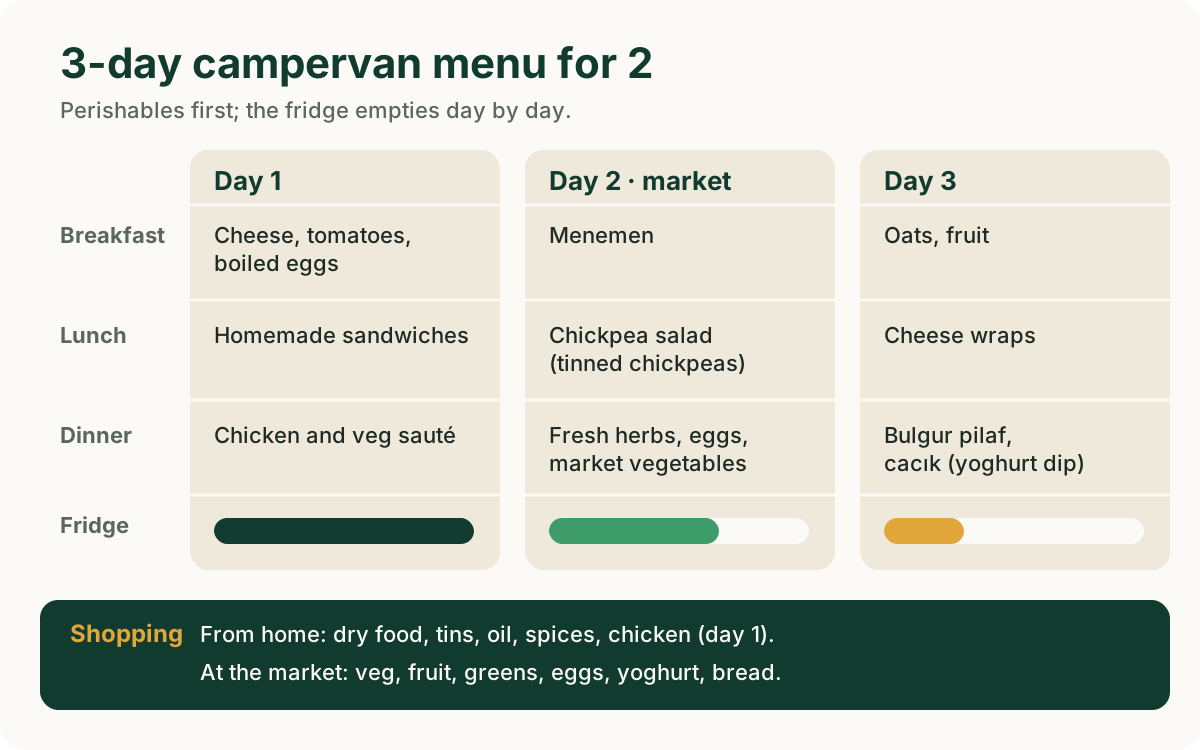
The plan below is for two people. The logic: fresh meat and chicken on day one, eggs and tins on day two, dry food and vegetables from the market on day three. The fridge empties day by day, and each day you need less cold.
| Where | What to buy |
|---|---|
| From home | Bulgur, pasta, oats, tinned chickpeas and tomatoes, olive oil, salt, spices, coffee, tea, chicken for day one |
| At a shop on the way | Bread, cheese, yoghurt, vegetables for day one |
| At the market (day 2) | Seasonal vegetables, fruit, greens and herbs, village eggs, bread |
Use plastic or metal containers rather than glass jars. They're lighter and don't break on bends.
The order for cooking on one burner
Most campervans have two burners, but you can also cook outside on a single camping stove. The secret with one burner is the order.
- First, what takes longest and keeps cooking by itself. Bulgur pilaf or pasta. When the pilaf has absorbed its water, take it off the heat, put the lid on and wrap it in a towel. It keeps steaming.
- Then what cooks quickly. Sautéed vegetables, menemen (Turkish scrambled eggs with tomato and peppers) or a sauce. It's ready in five to ten minutes while the pilaf rests in the towel.
- Tea or coffee last. While the burner is already hot.
To save water, cook pasta in little water with the lid on. Before throwing the cooking water away, you can use it to give pans and plates a rough soak. One-pot meals cut down on both water and washing up: menemen, bulgur with vegetables, stews made with tinned chickpeas instead of dried beans.
When cooking inside, open the roof vent or the extractor. Gas safety is a separate topic, covered in our campervan gas safety post.
Washing up and grey water
In a campervan, washing-up water goes into the grey water tank, which is usually smaller than the fresh water tank. To use less water:
- Wipe plates with kitchen paper or a scraper before washing. Put fat and scraps in the bin, not down the sink.
- The two-bowl method: one with soapy water and a little detergent, the other for rinsing. It uses far less water than washing under a running tap.
- Use little detergent. Even products labelled "biodegradable" shouldn't be poured onto the ground or into a stream.
Don't empty grey water onto the ground, into a ditch or onto the beach. Use the campsite's grey water and waste disposal point. Details in our post on water, electricity and waste in a campervan.
Shopping at the market
In many Aegean towns and neighbourhoods, a weekly street market (semt pazarı) is held on a set day. In villages you'll see smaller village markets or growers' stalls by the road. As market days and locations can change by municipal decision, it's best to ask the campsite or check the municipality's website. For the Urla and Ayvalık markets and seasonal produce, see our Aegean camp cooking post.
For campervanners, the market has two advantages. First, you can buy just what you need: half a kilo of tomatoes, a bunch of parsley, six eggs. That matters a lot with a small fridge. Second, local vegetables and fruit are usually in season and come from nearby, so they can keep better. Take a cloth bag and a few containers with lids. Olives and cheese in a plastic bag will make the campervan smell.
Storage that doesn't attract smells or animals
At campsites in Aegean and Mediterranean forests and on the edge of villages, cats, dogs, birds, ants and in some areas wild boar can be drawn by the smell of food. Simple rules:
- Don't leave food outside at night. That includes the table, under chairs and the crate under the awning.
- Keep rubbish in a closed, tied bag and take it to the campsite's bin point before going to bed.
- Store dry food in boxes with lids. An open bag of flour or sugar invites ants inside.
- Put fish and meat scraps in a separate, tightly tied bag.
- Don't feed wild animals. An animal that gets fed comes back every night and bothers the next guests too.
When choosing a pitch on the campsite map on Teknokamp, picking one close to the kitchen and washing-up area cuts down on carrying water and doing dishes.
Frequently asked questions
What if there's no fridge in the campervan?
Buy perishable food daily and eat it the same day. Plan around dry food, tins, hard cheese and long-lasting vegetables (onions, potatoes, carrots). For food planning in hot weather, see our camping in the heat post.
How much water do two people use for washing up?
It varies a lot with the method. To see your own use, do the first day's washing up in a bowl and measure how many litres you use, then plan the remaining days accordingly.
Can you pay by card at the market?
Some stalls take cards or bank transfers; many want cash. Carry some cash.
Do cooking smells linger in the campervan?
Frying and fish smells do. Cook those outside, open the roof vent when cooking inside, and take the rubbish out the same day.
Sources
- USDA FSIS: "Danger Zone" (40°F-140°F)
- USDA FSIS: Keep clear of the Danger Zone this summer
- Ministry of Agriculture and Forestry of Türkiye: General Directorate of Food and Control
- Teknovan: Campsites
Image credits
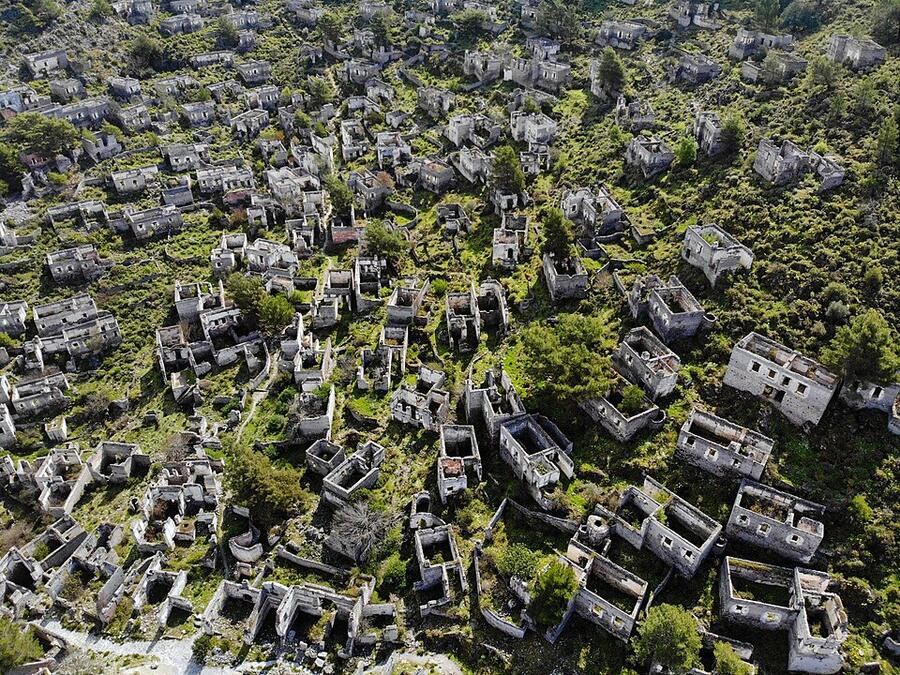
Photos illustrate the region; they are not photos of the campsites themselves.
- Karaburun: Bir_Ege_Hikayesi, CC BY 3.0, Wikimedia Commons