
Does a campervan holiday with kids have to be exhausting?
On a campervan holiday with children: what changes with age, who sits where on the road, how often to stop, and which rules to set at the campsite for roads, water and fire. A practical guide for families.
Teknovan Editorial Team ·
No, it doesn't. What usually makes a campervan holiday with children tiring is three things: long driving days, unclear rules and disrupted sleep. All three can be solved with planning. Keep daily driving short and decide on breaks in advance. When you arrive at the campsite, walk the boundaries together with the children. Keep bedtime close to what it is at home. In this post you'll find tips by age, seating on the road, safety at the campsite and a short plan for a driving day.
What changes with age?
Every age has different needs. The table below isn't a set of hard rules but a starting point drawn from situations families often face.
| Age | Main need | What helps |
|---|---|---|
| 0-2 | Sleep and feeding routine | Timing the drive with nap time, a familiar blanket and bed, a blackout blind |
| 3-6 | Movement and curiosity | Frequent short breaks, clear boundaries, their own small bag |
| 7-11 | Responsibility and play | Small jobs (water, setting the table), nature games, following the map |
| 12+ | Their own space and connection | A corner of their own, headphones, a say in route and plan decisions |
With young children, what helps most is repetition. Getting ready in the same order every evening (teeth, pyjamas, story) quickly turns the campervan into "home". With older children, it's giving them jobs. A child who fills the water container and checks the step sees the trip as their own business.
Who sits where on the road?
While the campervan is moving, everyone must sit in a seat with a seat belt, belt fastened. In motorhomes this usually means the cab seats and the forward-facing seats in the dinette. Side-facing benches, beds and bunks aren't for sitting in while driving. Don't exceed the number of seats in the registration document, and ask the hire company or manufacturer which seats have belts. Nobody travels inside a towed caravan. Everyone, children included, sits in the towing vehicle.
In Türkiye, the rules on child seats are set out in the Highway Traffic Law and the Highway Traffic Regulation. As of the time of writing (November 2026), Article 150 of the regulation requires children under a certain height and weight to be carried in a child restraint suitable for their height and weight. As these limits are sometimes quoted differently online, check the current height and weight thresholds in the text on mevzuat.gov.tr or with the Traffic Department of the General Directorate of Security.
In practice:
- Before handover, ask whether a child seat can be fitted to the campervan seat with ISOFIX or a belt. In some dinettes it may not be possible.
- If you're bringing your seat from home, fit it there and then on handover day, and give it a shake before setting off to check it's secure.
- On the road, make sure cupboards are closed and things on the table are put away. Even a thermos falling on someone's head in a hard stop can injure.
How often to stop, and the driving day
The general advice for adult drivers is to take a break about every two hours. For families with young children, this interval is usually even shorter. Keep the driving day short, choose breaks for the toilet, water and running around in advance, and arrive at the campsite in daylight.
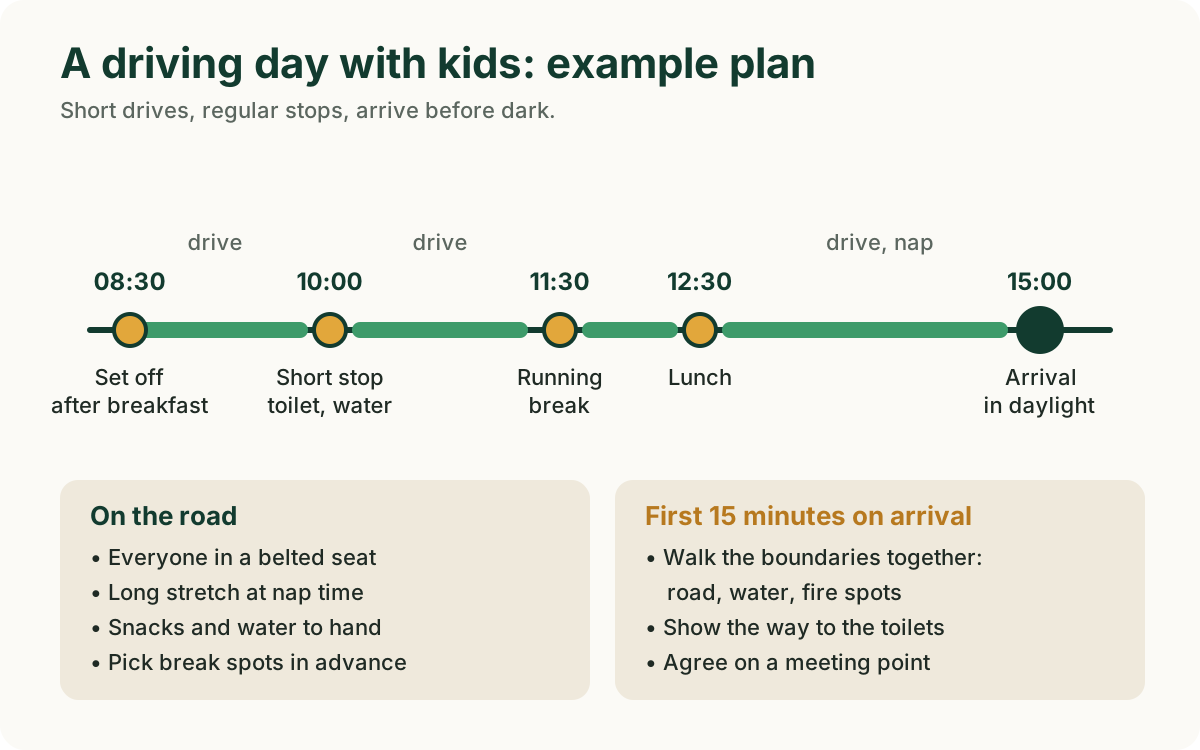
A few practical notes:
- Time the long stretch with nap time. The afternoon nap is the calmest driving time for most families.
- Keep snacks and water within reach. Stopping suddenly at the roadside is both dangerous and tiring.
- Choose break spots on the map in advance. Look for somewhere shady, away from traffic, with a toilet.
- A missed break can't be made up. Don't skip a planned break because "they're asleep anyway"; the driver needs a rest too.
For wind, descents and reversing techniques when driving a campervan, see our campervan driving techniques post.
Safety at the campsite: roads, water, fire
When you arrive, before setting up the campervan, take a fifteen-minute walk round with the children. Show them the way to the toilets, the playground and a meeting point. Then talk about three rules.
Roads. There's vehicle traffic inside the campsite too. The driver of a campervan parking or reversing may not see a small child. No cycling or ball games on the campsite tracks, and no playing behind campervans.
Water. By the sea, a stream, a pool or a lake, small children need uninterrupted supervision. The World Health Organization stresses that drowning is a significant cause of death among young children and highlights the importance of supervision. Take turns: the "water watcher" doesn't look at their phone while on duty.
Fire. The stove, barbecue and gas bottle are not a play area. Mark a "hot zone" around the stove. Fire bans in and near forests vary by season and province. Details in our camping in the heat post.
What to look for when choosing a campsite, such as water safety, a playground and quiet hours, is covered in our post on five things families look for in a campsite. Because Teknokamp lets you choose a pitch on the campsite map, you can pick one that overlooks the playground and toilets and sits at the end of a vehicle track.
Play and sleep routine
Keep toys to a minimum in a campervan, because every item takes up a cupboard. Nature is the playground anyway. A few ideas:
- Nature bingo. Write pine cone, feather, seashell and round stone on a sheet of paper. Whoever finds one ticks it off.
- Camp diary. A drawing or a sentence every evening. It becomes the most precious souvenir when you get home.
- Map reader. An older child follows the day's route on a paper map.
- Star time. On a clear night, look at the sky for five minutes before bed.
For sleep, stay close to home bedtime. Bring a blackout blind or a thick cover; on the Aegean in summer the sun rises early. For a child sleeping in the top bunk, check the guard rail, and if there isn't one, move the bed downstairs. Put a small night light by the door for a child who gets up for the toilet at night. Campsite quiet hours are the rule families find most useful; ask the times at check-in.
Frequently asked questions
Can you go on a campervan holiday with a baby?
Yes, but keeping driving days short and protecting the sleep routine becomes even more important. Find out in advance whether the child seat can be fitted properly in the campervan.
Can the children sit at the table in the back while driving?
Only in seats that have a seat belt and are counted as seats in the registration document, with the belt fastened. If a child seat is needed, make sure it can be fitted in that place. Check the current rule in an official source.
How often should we stop?
The general advice for drivers is a break about every two hours. With young children, stopping more often makes the journey easier for most families.
What if a child gets lost at the campsite?
Go to the agreed meeting point and tell the campsite reception straight away. Show your child the reception and your pitch number on the first day.
Sources
- Highway Traffic Law No. 2918 (mevzuat.gov.tr)
- General Directorate of Security, Traffic Department
- World Health Organization: Drowning (fact sheet)
- NHTSA: Car seats and booster seats
- Teknovan: Campsites
Image credits
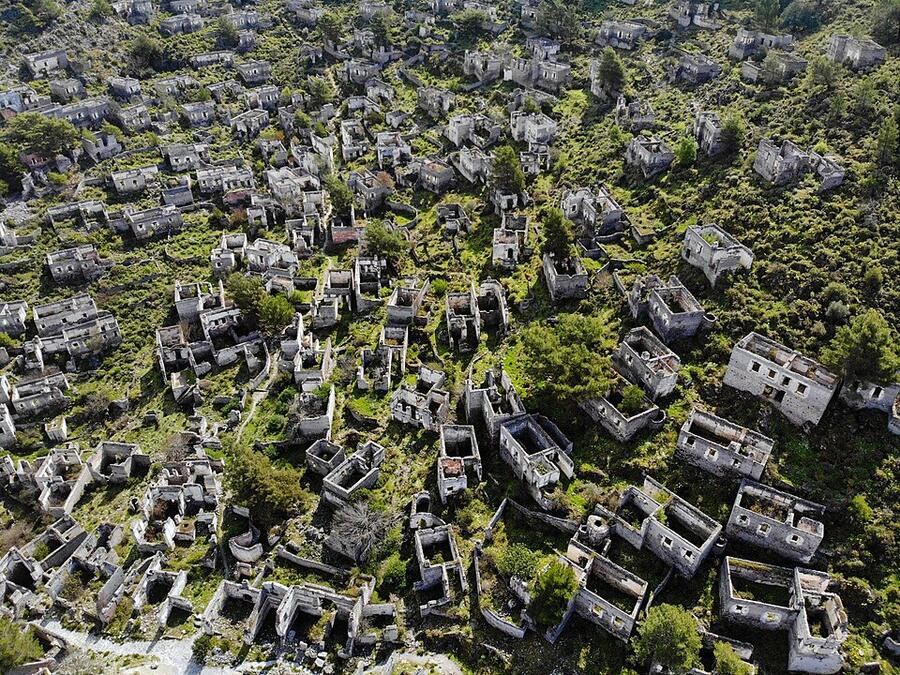
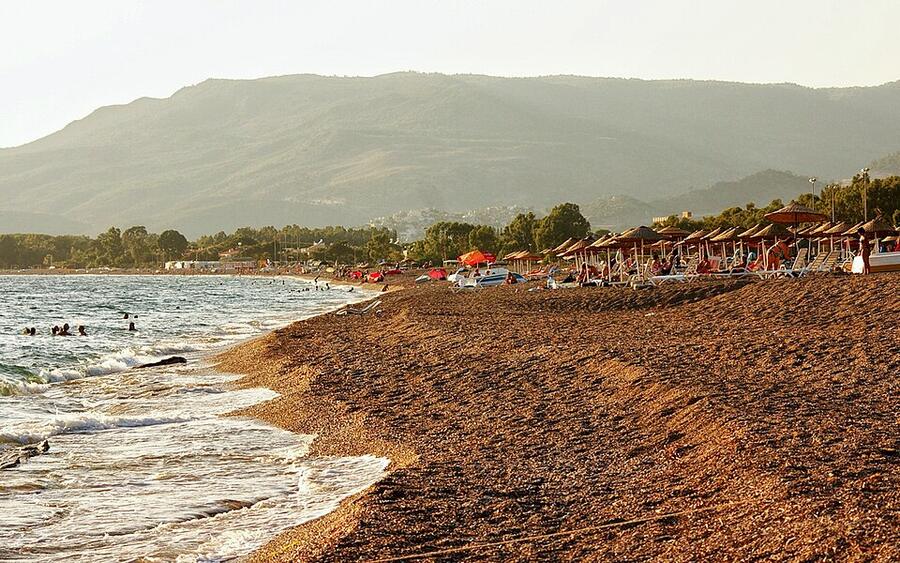
Photos illustrate the region; they are not photos of the campsites themselves.
- Özdere: CherryX, CC BY-SA 3.0, Wikimedia Commons