
Motorhome, towed caravan or camper van?
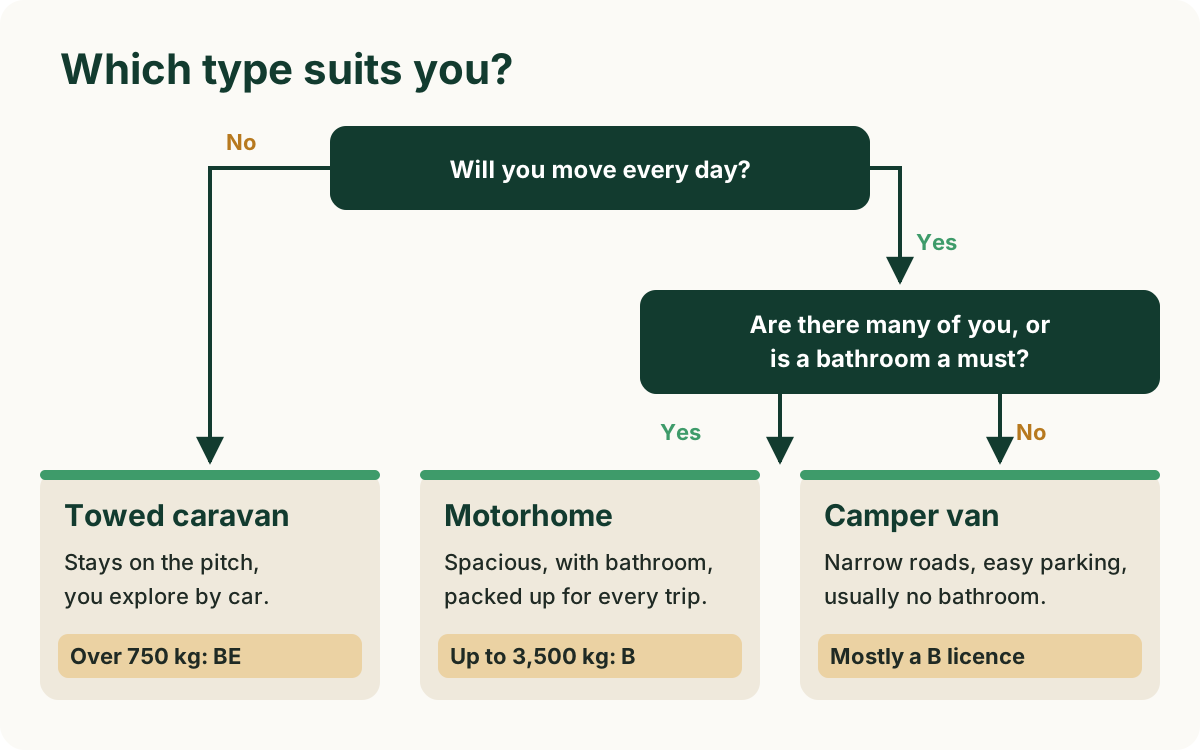
We compared three types of campervan side by side on licence, driving, parking, everyday use at the campsite and hire. At the end there's a short decision flow to help you find the type that suits you.
Teknovan Editorial Team ·
Short answer: if you'll spend most of your holiday on the road and move every day, a motorhome makes more sense; if you'll settle at one campsite and explore the area by car, a towed caravan; and if you're two people who also want to get down narrow village roads and into town car parks, a camper van. Your licence, your car's towing capacity and how many of you there are often narrow the choice for you.
Below we compare the three on the same criteria. The terms are used loosely in hire listings, so let's first be clear about what's what.
Three types, three ways of living
- Motorhome: A vehicle with the engine and living space in one body. It's usually built on a van chassis and has a toilet and shower, a fixed bed, a kitchen and water tanks. You can walk through from the cab to the living area.
- Towed caravan: A trailer with no engine, attached to the back of a car with a towbar. Inside it's similar to a motorhome, but when you arrive at the campsite you unhitch it and the car is free.
- Camper van: A panel van or minibus fitted out inside with a bed, a small kitchen and storage. It usually has no toilet or only a portable one, and most models have no shower. It's small enough to use as an everyday vehicle.
Licence: the weight in the registration document decides
What you can drive on which licence depends on the maximum authorised mass in the registration document. As of the time of writing (November 2026), under Türkiye's Highway Traffic Regulation the rough picture is:
| Vehicle | Licence category usually required |
|---|---|
| Camper van or motorhome up to 3,500 kg maximum authorised mass | B |
| Car + towed caravan up to 750 kg maximum authorised mass | B |
| Car + towed caravan over 750 kg | BE |
| Motorhome over 3,500 kg maximum authorised mass (up to 7,500 kg) | C1 |
Almost all camper vans can be driven on a B licence. With large motorhomes, always check the registration document; some models exceed 3,500 kg. With a towed caravan there are two separate limits: your licence and the towing capacity in your car's registration document. Family caravans with a bathroom often exceed 750 kg, in which case a B licence isn't enough. For the detailed table, speed limits and HGS toll classes, see our guide to campervanning on Turkish roads.
Driving, parking and a day at the campsite
The real difference between the three shows up after you arrive at the campsite.
| Criterion | Motorhome | Towed caravan | Camper van |
|---|---|---|---|
| Driving | Long and tall, sensitive to crosswinds | Hardest, reversing takes experience | Like a big minibus |
| Parking in town | Hard, gets caught by height barriers | Almost impossible with the caravan | Fits most open car parks |
| Setting up at the campsite | Water, electricity, levelling blocks; quick | Unhitching, corner steadies; a bit longer | Quickest |
| Day trips | You pack everything up every time you go out | The caravan stays, you explore by car | Easy to pack up, but you still have to |
| Interior space and bathroom | Spacious, with bathroom | Spacious, with bathroom | Cramped, usually no bathroom |
| Narrow village roads | Risky | Very risky | Fine |
A motorhome's strength is that the kitchen and toilet are ready wherever you stop. Its weakness is that once you've settled in at the campsite, even going to the bakery for bread means unplugging the cable, winding in the awning and securing the cupboards. Carrying a bike or scooter solves this to some extent.
A towed caravan is for people who stay in one place for a week. You leave the caravan on the pitch and drive down to bays and village markets in the car. You pay for it on the road: driving, parking and especially reversing with a trailer take practice. The regulation also sets lower maximum speeds for vehicles towing a trailer.
A camper van is the most flexible option for couples and solo travellers. It gets into car parks without height barriers and down narrow coast roads. In return the interior is cramped, and on a rainy day you can feel boxed in. You rely on the campsite's facilities for the toilet and shower, so it's important to choose sites with clean showers and toilets.
How many of you are there, and how long will you stay?
A few more questions make the choice easier:
- How many of you are there? A camper van is usually too cramped for a family of four. A motorhome or towed caravan with fixed beds and a bathroom is more comfortable.
- How many nights in the same place? If you move every night, a motorhome or camper van makes sense. If you stay at the same site longer than three nights, the towed caravan's advantage grows.
- Any nights without hook-up? Without a toilet, nights without hook-up get harder in a camper van. Plan your power needs with our campervan power budget post.
- Bringing a pet? Since you can't leave the vehicle closed even briefly in summer, shade and a hook-up for air conditioning at the campsite become important. We cover this in our keeping a campervan cool post.
What to check when hiring
Most hire listings in Türkiye are for motorhomes and camper vans. Hiring a towed caravan is possible, but your car needs a towbar, the right registration and, if required, a BE licence. Make sure these are in writing in the hire contract:
- Licence category and minimum licence age requirement.
- Maximum authorised mass in the registration document and the vehicle's height.
- How the gas, battery and water system will be shown to you at handover.
- What the insurance covers: are the awning, windows, interior fittings and roadside assistance included?
- Mileage limit and permission to travel abroad.
If you're hiring for the first time, take our first campervan trip checklist with you on handover day. Spending the first night at a site with electricity and water makes things easier with all three types. If you'd like to start near İzmir, you can look at the page for campervan parks such as NovaUrla Karavan Park, and on Teknokamp choose your pitch on the site map and book.
Frequently asked questions
Can I drive a motorhome on a B licence?
You can drive a motorhome or camper van with a maximum authorised mass of up to 3,500 kg in the registration document. Heavier models need C1. For the rule in force at the time of writing, see the Highway Traffic Regulation.
Is a towed caravan or a motorhome cheaper?
There's no single answer. With a towed caravan you use your own car, but fuel consumption and the motorway toll class change with a trailer. Compare prices using your own route, number of days and current hire quotes.
Can you camp in a camper van without a toilet?
Comfortably, at a campsite with facilities. If you'll stay somewhere without hook-up, you'll need a portable chemical toilet and a plan for emptying it.
Do I need to tell the campsite the vehicle type before arriving?
Yes. The pitch size, ground and access road vary by type. If you're coming with a towed caravan, ask about turning space too.
Sources
- Highway Traffic Regulation, Legislation Information System
- Highway Traffic Law No. 2918 (mevzuat.gov.tr)
Image credits
Photos illustrate the region; they are not photos of the campsites themselves.
- Erdek: Ozgur1000, CC BY-SA 3.0, Wikimedia Commons